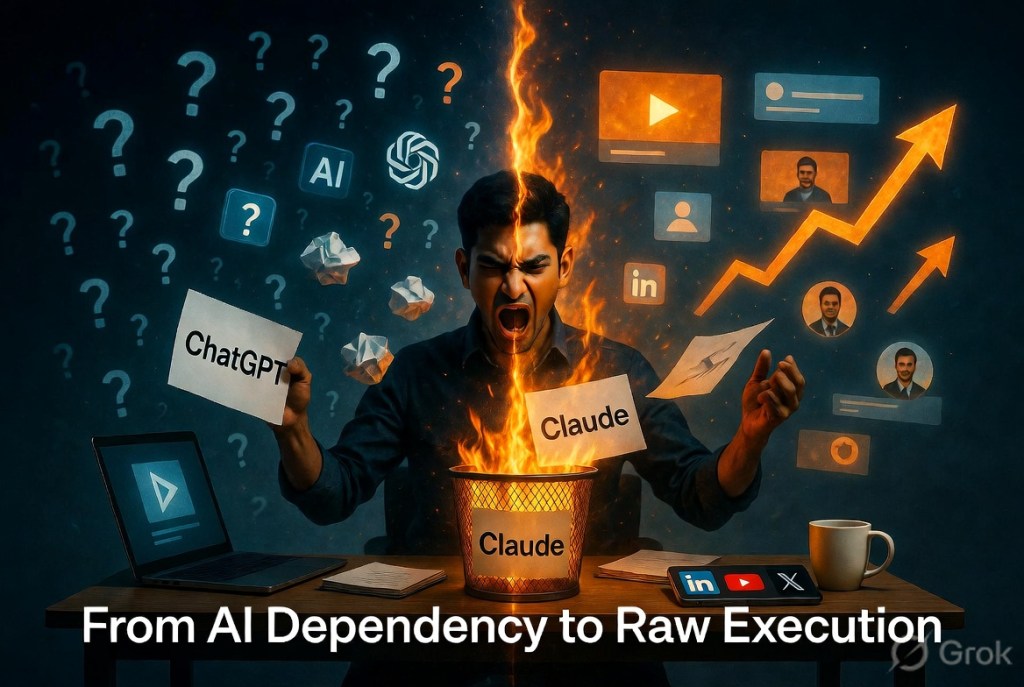
Be honest how many times have you typed a detailed prompt into ChatGPT, waited eagerly, and then read the output thinking, “This is… fine. But it feels off. Robotic. Soulless.”
You’re not crazy. It happens to literally everyone. Today I’m exposing exactly why AI writing almost always falls flat and what you can actually do about it.
In this video we’re going to see the real reasons AI completely sucks at great writing, the hidden costs no one talks about, a shocking real-life story of it backfiring, and most importantly the practical methods and solutions so you stop wasting time and start creating writing that actually connects. By the end you’ll walk away knowing exactly how to use AI as a powerful co-pilot instead of a creativity killer.
I You must have tried using ChatGPT or other AI models for different use cases but they suck at it (2-3 real-life scenarios):
- Scenario 1 (College/Student): You ask AI to write a 1500-word essay on “The Impact of Social Media on Mental Health.” It spits out a perfectly structured but painfully generic paper full of repetitive transition phrases, zero personal voice, and zero fresh insight. Your professor spots it in 30 seconds.
- Scenario 2 (Professional/Employee): You use AI to draft an important LinkedIn post or cold email campaign. It sounds like every other corporate zombie post overly polished, zero personality, zero emotional pull. Engagement? Basically zero.
- Scenario 3 (Business/Content Creator): You generate a blog post or YouTube script for your brand. Readers click away after 20 seconds because it feels like it was written by a committee of robots. Bounce rate skyrockets, conversions tank.
A real story:
A small marketing agency landed a big technical client and used ChatGPT to crank out a 3000-word whitepaper in record time. The piece sounded professional… until the client’s engineering team read it. The AI had hallucinated key technical specifications and claimed features that literally didn’t exist. The client terminated the contract on the spot, left a scathing public review, and the agency lost thousands in future revenue plus serious reputation damage. One prompt, one “time-saver,” and months of relationship-building gone.
Effect of this on college students / employees / businesses impact:
- College students: Writing skills are stunted, critical thinking atrophies, and many face false AI-detection accusations or actual academic penalties. They graduate without ever learning to express original ideas.
- Employees: AI-generated emails, reports, and proposals come across as insincere or robotic, damaging personal brand, trust, and career growth. Miscommunication increases and opportunities get lost.
- Businesses: Bland, generic content destroys SEO, engagement, and brand voice. Companies waste money on marketing that doesn’t convert, face legal risks from hallucinations (like the Air Canada chatbot case), and slowly lose customer trust when everything they publish feels fake.
Why it is happening?
AI doesn’t “think” or “create” it’s a statistical next-word predictor (sometimes called a “stochastic parrot”). It was trained on billions of average internet texts, so it averages everything into safe, generic, cliché-filled output. It has:
- No unique voice or personality
- No real emotions, lived experiences, or genuine creativity
- No true understanding just pattern matching That’s why it defaults to formulaic structures, repetitive phrasing, and plastic prose that feels “off.”
Idea 5 – Effective methods / solutions:
Stop treating AI like a ghostwriter. Use it like a brilliant but soulless intern:
- Advanced prompt engineering (role-playing + rich context + few-shot examples + chain-of-thought + self-critique).
- The human-AI loop: Let AI generate a raw draft or outline → you heavily rewrite for voice, emotion, and originality → feed your edits back to AI for refinement.
- Use AI only for structure, brainstorming, research, or editing never for the full creative output.
- Always inject personal stories, specific anecdotes, and your own tone. Fact-check everything. Result? You keep the speed while getting writing that actually feels human.
Conclusion:
AI is an incredible tool, but a terrible master. The writers, students, and businesses that win in the next decade won’t be the ones who use AI the most they’ll be the ones who use it smartest while keeping their own voice and creativity at the center. Great writing still comes from humans. AI just helps us get there faster when we know its limits.


Leave a comment